.webp)
.webp)


.webp)


.png)
Get A Full SaaS Design Team For Less Than Hiring In-House
Work With A Dedicated Team
Launch Products In Weeks
Scale Your Product Team
Focus On Growing Your SaaS
Design and Development, Made Simple
What SaaS Teams Say About Working With Orbix Studio
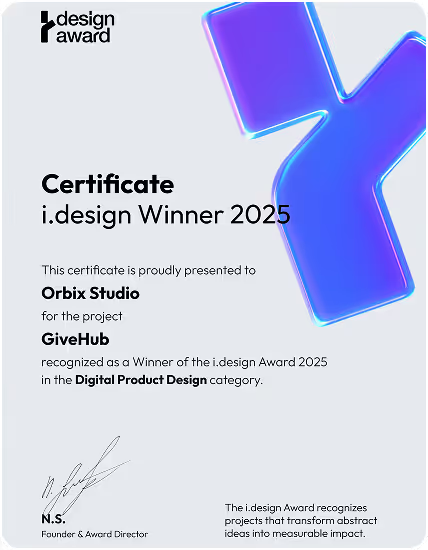
GiveHub -
Awards & Honors


Monthly Product Support as You Grow
Fixed Monthly Rate
fee every month.
Fast Delivery
times on every request.
Premium Quality
output on every task.
Scalable & Flexible
your current roadmap
Unique & Custom
Strategic Design Board
queue in one place.
Got Questions?
We’ve Got Answers
If you’re unsure where to start or want to see how we can help, reach out, and we’ll walk you through it.

Book an Intro Call
What does a B2B SaaS product design agency actually do?
A B2B SaaS product design agency turns a product idea, a messy workflow, or an unclear interface into something a user can complete without help. The work usually starts with a real business goal: a stalled trial-to-paid conversion, a support queue full of the same three questions, or a sales team promising features the current UI cannot support.
From there, the agency maps how a specific user type moves through the product today, where that path breaks down, and which change removes the most friction first.
A single engagement can cover product UX, a design system, brand identity, a marketing site built in a tool like Webflow, motion for a product demo, or full-stack development to ship the result. What separates a useful agency from a decorator is sequencing: work that follows the user’s actual workflow, not a template borrowed from another industry.
Orbix Studio works this way, starting every SaaS or AI engagement with the business goal and the workflow it affects, then scoping design and development around that one problem before expanding into anything larger.
What kind of company benefits most from a SaaS product design partner?
Orbix Studio runs on flat monthly plans: $2,999/month for the Startup plan (100 hours) and $5,499/month for Scale-ups (200 hours). Both include design and development in oThe best fit is a B2B SaaS or AI team that already has a working product and a specific problem it cannot solve alone: low activation, a support team fielding the same confusion every week, or a roadmap that has outgrown the original interface.
A design partner adds the most value when the team has real user data, a person who can make product decisions quickly, and the willingness to review work on a regular cadence rather than once at the end.
Early-stage teams without a live product can still benefit, particularly when they need to validate a workflow before writing production code. What matters less than company size or funding stage is clarity: a team that can describe the user, the current journey, and the business outcome it needs will get more from an outside partner than one still debating what the product should be. Fit also depends on collaboration style.
Teams that treat a design partner as an extension of the product team, sharing context and constraints openly, get sharper work than teams that hand over a brief and disappear until launch.ne retainer, so there are no hourly invoices and no surprise overages. Most comparable agencies charge $3,000–$15,000/month for design alone.
Can a design partner help before your MVP is fully built?
Yes, and the earlier a design partner joins, the cheaper the mistakes are to fix. Before development starts, the highest-value work is defining the first user flow: what a new user needs to do to reach one meaningful outcome, and which steps in that path can be removed entirely. A clickable prototype tests that flow with real people before a single line of production code exists, which costs far less than rebuilding a shipped feature nobody used.
This stage should resist the urge to design every screen a competitor has. An MVP earns its name by solving one job well, not by matching a mature product’s feature list. A design partner’s job here is restraint: identify the smallest workflow that proves the core value, design it clearly, and leave the rest for after real users generate evidence about what to build next.
Build-ready screens, a basic design system, and a tested prototype give an engineering team a clear target instead of a moving one. Skipping this stage rarely saves time. It usually means rebuilding the same screens twice, once to ship something and once to fix what users could not figure out.
How does a design agency decide what to work on first?
A design agency should start with the product goal, not a wishlist of screens. The first question is which workflow affects revenue most directly right now: activation, conversion, retention, or support load. Whichever workflow shows the clearest evidence of a problem, drop-off data, repeated support tickets, or a stalled trial, becomes the first scope, because fixing it produces a measurable result the rest of the roadmap can build on.
Delivery constraints shape scope just as much as ambition does. A team with two engineers and a six-week deadline needs a different first scope than one with a full squad and a quarter to work with. A useful agency states these trade-offs plainly rather than promising everything at once.
Orbix Studio sets scope this way: goal first, workflow second, team capacity third, then expands only after the initial work proves what actually moves the number the business cares about.
That sequencing matters more than the size of the first release. A narrow scope that changes a real metric earns the trust needed for a second, larger engagement, while a broad scope that changes nothing measurable rarely gets a second chance.
Should you hire a design agency or build an in-house product team?
Hire an agency when you need a focused, cross-functional team faster than you can recruit, hire, and onboard one internally, especially for a defined project like a redesign, an MVP, or a marketing site rebuild. Agencies bring range: a single engagement can draw on UX, brand, motion, and development skill without the overhead of five separate hires and five separate management relationships.
Build in-house when design work is constant rather than project-based, when leadership can commit budget to grow and retain a team over years, and when deep, compounding product knowledge matters more than short-term flexibility.
In-house teams build institutional memory: they know why a decision was made two years ago and what broke last time a feature shipped without proper review. That memory is hard for any outside partner to replicate quickly.
Many growing SaaS companies use both approaches together: an in-house team for ongoing product work, paired with an outside partner for spikes in capacity, specialist skills like motion or illustration, or a project with a hard deadline. The right mix depends on how steady the workload is, not on which option looks better on paper.
What happens on an Orbix Studio discovery call?
An Orbix Studio discovery call is a 30-minute working conversation, not a sales pitch. It starts with your product: what it does, who uses it, and the specific problem prompting the call, whether that is a stalled activation rate, a marketing site that no longer matches the product, or a team that needs extra delivery capacity. From there, the call covers your current team setup, timeline, and how you will measure success.
You should leave the call with three things: an honest answer on whether the fit is real, a recommendation for which service should come first, and a clear list of what Orbix needs from you to put together a reliable scope, such as analytics access, existing design files, or a technical constraint document. If the problem needs more diagnosis before a scope makes sense, the call will say so directly rather than rushing to a proposal.
Nothing is decided or billed during the call itself. It exists to confirm whether Orbix and your team are solving the same problem, because a scope built on a misunderstanding costs more to unwind later than the 30 minutes it takes to get the fit right up front.
How do you start a project with Orbix Studio?
Start by booking a 30-minute discovery call and bringing four things: your product link, the business goal behind the project, your timeline, and a description of the specific workflow that needs attention. That context lets Orbix confirm fit before either side spends time on a formal proposal, and it usually surfaces the first useful question faster than a written brief would.
After the call, Orbix recommends a first scope: the specific piece of work that should happen before anything larger. The proposal that follows states what is included, what is excluded, the review process, and who owns the resulting files, designs, and code once the engagement ends. Kickoff begins once that proposal is signed. An alignment session confirms tools, decision makers, and the first review milestone, so the team starts working against a shared understanding rather than assumptions on either side.
Feedback happens in scheduled batches rather than all at once at the end, which means each round of work informs the next decision instead of arriving after it is too late to change course. Teams that arrive with real user data or analytics tend to move through this process fastest.
How do you start a project with Orbix Studio?
Start by booking a 30-minute discovery call and bringing four things: your product link, the business goal behind the project, your timeline, and a description of the specific workflow that needs attention. That context lets Orbix confirm fit before either side spends time on a formal proposal, and it usually surfaces the first useful question faster than a written brief would.
After the call, Orbix recommends a first scope: the specific piece of work that should happen before anything larger. The proposal that follows states what is included, what is excluded, the review process, and who owns the resulting files, designs, and code once the engagement ends. Kickoff begins once that proposal is signed. An alignment session confirms tools, decision makers, and the first review milestone, so the team starts working against a shared understanding rather than assumptions on either side.
Feedback happens in scheduled batches rather than all at once at the end, which means each round of work informs the next decision instead of arriving after it is too late to change course. Teams that arrive with real user data or analytics tend to move through this process fastest.
How do you start a project with Orbix Studio?
Start by booking a 30-minute discovery call and bringing four things: your product link, the business goal behind the project, your timeline, and a description of the specific workflow that needs attention. That context lets Orbix confirm fit before either side spends time on a formal proposal, and it usually surfaces the first useful question faster than a written brief would.
After the call, Orbix recommends a first scope: the specific piece of work that should happen before anything larger. The proposal that follows states what is included, what is excluded, the review process, and who owns the resulting files, designs, and code once the engagement ends. Kickoff begins once that proposal is signed. An alignment session confirms tools, decision makers, and the first review milestone, so the team starts working against a shared understanding rather than assumptions on either side.
Feedback happens in scheduled batches rather than all at once at the end, which means each round of work informs the next decision instead of arriving after it is too late to change course. Teams that arrive with real user data or analytics tend to move through this process fastest.
How do you start a project with Orbix Studio?
Start by booking a 30-minute discovery call and bringing four things: your product link, the business goal behind the project, your timeline, and a description of the specific workflow that needs attention. That context lets Orbix confirm fit before either side spends time on a formal proposal, and it usually surfaces the first useful question faster than a written brief would.
After the call, Orbix recommends a first scope: the specific piece of work that should happen before anything larger. The proposal that follows states what is included, what is excluded, the review process, and who owns the resulting files, designs, and code once the engagement ends. Kickoff begins once that proposal is signed. An alignment session confirms tools, decision makers, and the first review milestone, so the team starts working against a shared understanding rather than assumptions on either side.
Feedback happens in scheduled batches rather than all at once at the end, which means each round of work informs the next decision instead of arriving after it is too late to change course. Teams that arrive with real user data or analytics tend to move through this process fastest.


.avif)

%20(1).avif)
.avif)

.avif)
.avif)


.avif)
.avif)
.avif)


.avif)


.avif)